

You really haven’t lived until you’ve gone out to dinner — outside seating — at 29 degrees! More about that shortly. We’re back from 10 days in our beloved Wallowa Mountains. Spending a winter in the Wallowas, the land from which my people come, has been on my “bucket list.” In that far corner of Northeast Oregon is where the family cabin is located. This 10 days was a down payment on that bucket-list item.
Thanks to our friends, David Laskin and Kate O’Neill, we had a most lovely place to stay. Our own cabin is, alas, not “winterized.” Moreover, what makes it an attractive location on hot summer days, that it is located in the vortex between Mt. Howard and Joseph Mountain, has the opposite — chilling — effect in winter. Little sun to warm away the deep frozen everything.

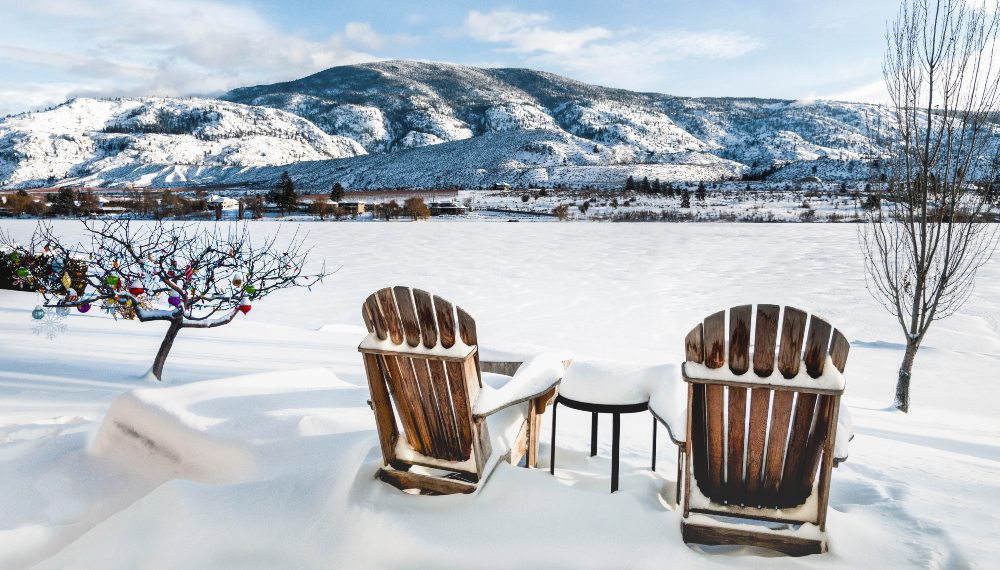
Staying at David and Kate’s we were out on the prairie, east of the small town of Joseph, with a spectacular view of the mountains. A great perch for watching the weather roll through. This photo is from David and Kate’s southwest facing porch.
While there we took part in the winter program of “Fishtrap,” a writers workshop dedicated to “clear thinking and good writing about the West.” The theme was “Resilience,” and the presenters were members of the Nez Perce tribe.
Bands of Nez Perce spent summers in the Wallowas for centuries. In the winter they headed down into the warmer canyons of the Imnaha and Snake Rivers. It all changed with the coming of white folks. First, the miners, then the missionaries, then settlers, arrived in the mid-19th century. After many sad chapters the Nez Perce were forced onto a reservation near Lapwai, Idaho. Gradually, the Nez Perce people have been returning to the Wallowas. And the tribe is becoming a much bigger player in the County through the re-assertion of native fishing rights and a role in management of the fishery. Work is underway to restore ancient salmon runs, though that project faces formidable obstacles, some of which are literal, i.e. the many dams on the Snake and Columbia rivers.
For our speakers, “resilience” had everything to do with knowing the story of one’s people and family, their names and legends, qualities and values. Important too is to know where they are buried. When we, white folks, were asked about our family history most of us (there were a few exceptions) could only go back as far as our immigrant grandparents. Which is mostly true for me. The common element in the story of my grandparents and parents is Wallowa County. My grandparents lived there. My parents were raised there. Our quaint, old-timey cabin dates to 1926.
So my own story is tied up, as are those of many in the Northwest, with the dispossession of native peoples. We and I continue to come to grips with this.
On the way home, we stopped to visit our daughter, Laura, in White Salmon, Washington in the Columbia Gorge. White Salmon is due north across the Columbia from the more well known town of Hood River in Oregon. Once a sleepy community of apple and pear orchards, Hood River has been transformed by wind surfers, kite-surfers and other outdoor activities.
Laura wanted to support a new restaurant in White Salmon, one that had just succeeded in getting its liquor license. But Washington Gov. Jay Inslee has clamped down again with renewed COVID restrictions, so no indoor dining, even if socially distanced. There was a line of tables outside behind a bamboo screen that wasn’t fooling anyone, least of all Mother Nature.
So, what do you do when dining outside at 29 degrees? Order Margaritas of course! Dinner was great. The wait staff were so happy we were there. But, damn, it was cold. That goes in the memory banks for the Great Pandemic, which we all hope will be a memory before too much longer.
Discover more from Post Alley
Subscribe to get the latest posts sent to your email.